Irboserbix
Align Blueprint
Align Blueprint
Couldn't load pickup availability
1. Problem Statement — When Every Component Needs Its Place
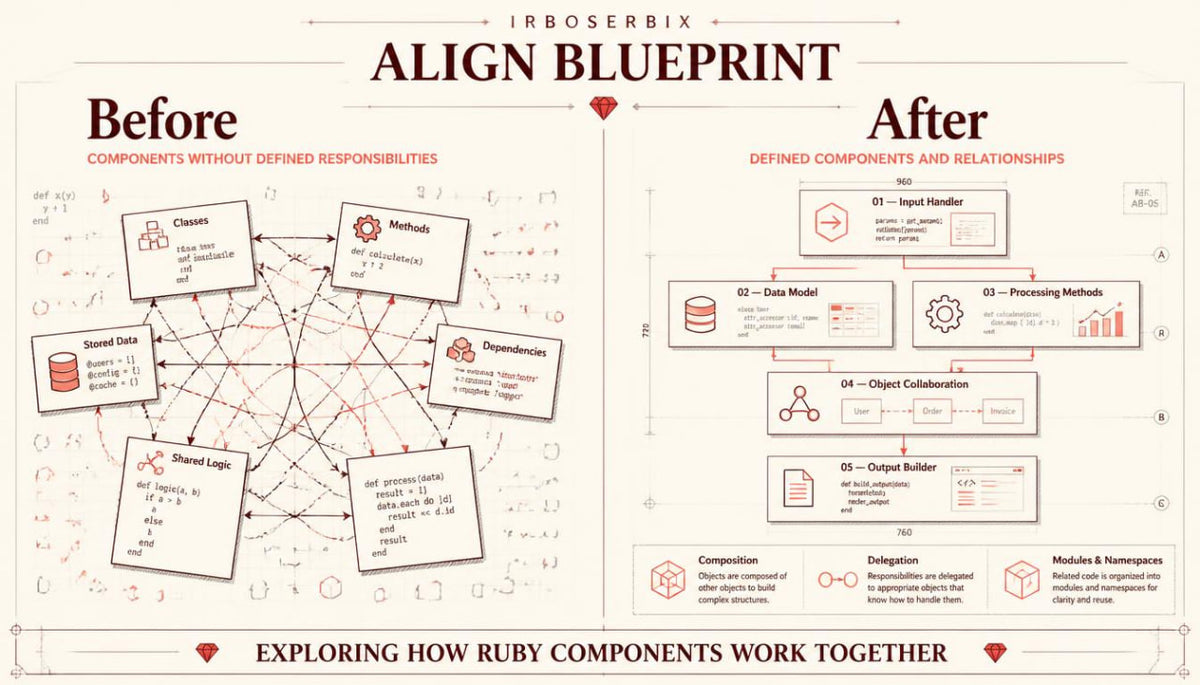
As Ruby programs expand beyond individual classes and methods, understanding how their components should interact becomes an increasingly important part of programming study. Learners may recognize object-oriented concepts but still encounter difficulties when deciding how responsibilities should be distributed across several classes. Repeated logic, complicated method relationships, and unclear dependencies can make connected code difficult to read and maintain. Organizing multiple source files introduces additional questions about how classes communicate, where shared behavior belongs, and how information travels between different sections. These challenges create a need for educational materials that explain Ruby architecture through practical examples, structural comparisons, and carefully organized coding exercises.
2. Solution — Connecting Structure, Purpose, and Behavior
Align Blueprint introduces Ruby program organization through a structured examination of classes, modules, dependencies, and object relationships. Each learning module explores a particular architectural concept and demonstrates its role within connected programming examples. Guided activities encourage learners to identify responsibilities, examine interactions between objects, and compare different approaches to arranging related instructions. The course also introduces modular code organization, composition, method delegation, and introductory approaches to examining program behavior. Through detailed explanations, annotated examples, and practical review exercises, Align Blueprint provides an organized setting for studying how Ruby components can work together within larger programming structures.
3. What's Inside — A Blueprint for Understanding Ruby Architecture
Align Blueprint contains eight educational modules that examine the relationships between program structure, object behavior, and code organization.
The course builds upon foundational Ruby knowledge, particularly classes, modules, collections, methods, and introductory exception handling.
Each section combines technical explanations with practical examples that illustrate how individual components contribute to a connected program.
Module 01 — Understanding Program Architecture
The opening module introduces program architecture as the arrangement of related components and responsibilities.
Learners examine how Ruby programs can be divided into logical sections according to the operations they perform.
Topics include class responsibilities, method relationships, information flow, and the separation of different programming concerns.
Annotated examples demonstrate how a single collection of instructions can be reorganized into several cooperating components.
Activities encourage learners to identify the purpose of each component and describe how it contributes to the overall program.
Module 02 — Designing Classes with Defined Responsibilities
Classes provide a way to organize related information and behavior, but their responsibilities require careful consideration.
This module examines how class definitions can represent particular concepts within a Ruby program.
Learners explore instance variables, initialization methods, public behavior, and internal helper methods.
Examples compare classes containing several unrelated operations with structures that divide responsibilities among different objects.
The materials also introduce introductory considerations involving class size, method purpose, and naming conventions.
Practical exercises involve examining class definitions and identifying relationships between stored information and available methods.
Module 03 — Object Collaboration and Communication
Ruby programs frequently contain objects that exchange information and request operations from one another.
This module explores how objects communicate through method calls and shared references.
Learners examine examples where one object receives another object as an argument or works with information returned by a cooperating component.
The section introduces object collaboration through scenarios involving organized records, categorized information, and coordinated calculations.
Annotated examples illustrate how data moves between different objects while each component maintains its own responsibilities.
Exercises invite learners to trace object interactions and identify the role of individual method calls.
Module 04 — Composition and Inheritance
Ruby provides different approaches to sharing behavior and organizing relationships between classes.
This module examines inheritance and composition as two distinct structural techniques.
Learners revisit parent and child class relationships, inherited methods, method overriding, and the use of super.
The materials then introduce composition through examples where an object works with other objects rather than inheriting their behavior.
Structural comparisons demonstrate how the same programming scenario can be represented through different class relationships.
Practical activities encourage learners to examine these arrangements and describe their respective characteristics.
Module 05 — Modules, Namespaces, and Source Organization
As programs contain additional classes and methods, source organization becomes an important subject.
This module explores Ruby modules as tools for grouping related behavior and organizing names.
Learners examine module definitions, constants, nested structures, and introductory namespace organization.
Examples demonstrate how modules can group related classes and distinguish components serving different purposes.
The materials also discuss arranging Ruby definitions across several source files and connecting them using language-level loading mechanisms.
Exercises focus on reading organized source structures and identifying relationships between files, modules, and class definitions.
Module 06 — Dependencies and Method Delegation
Connected programs often rely on one component to perform an operation required by another.
This module introduces dependencies and explores how they influence communication between objects.
Learners examine constructor arguments, object references, method delegation, and introductory dependency injection.
Annotated examples demonstrate situations where one class receives a cooperating object instead of creating every related component internally.
The section also introduces Ruby's flexible approach to object behavior, including the idea that objects can cooperate through shared method expectations.
Review activities focus on tracing delegated operations and examining how responsibilities move between cooperating components.
Module 07 — Reviewing Structure and Program Behavior
An organized program structure provides opportunities to examine components individually and as part of a connected system.
This module introduces code review techniques focused on method behavior, object relationships, and expected outputs.
Learners explore introductory testing concepts through simple checks and sample data.
The materials demonstrate how a method can be examined separately before its behavior is reviewed within a larger operation.
Examples also introduce common structural issues, including repeated instructions, unclear responsibilities, and unnecessary connections between components.
Practical activities encourage learners to interpret code behavior, compare arrangements, and document observations.
Module 08 — A Connected Ruby Architecture Workshop
The concluding module brings the course topics together through a guided programming scenario.
Learners examine a small information-management program containing several classes, modules, and cooperating objects.
The activity begins by identifying the responsibilities associated with recording information, organizing entries, and preparing output.
Subsequent stages demonstrate how classes can be connected through method calls, object references, and delegated operations.
The materials include annotated code examples and explanations of the relationships between individual components.
Review questions invite learners to trace information flow, examine class responsibilities, and consider alternative structural arrangements.
Additional Course Materials
Align Blueprint includes supporting educational resources that complement the main learning modules.
-
Architecture diagrams: Visual explanations of class relationships, object collaboration, and information movement.
-
Annotated Ruby examples: Code fragments accompanied by detailed descriptions of their structural roles.
-
Class organization worksheets: Activities involving the identification and separation of component responsibilities.
-
Composition and inheritance comparisons: Written examples illustrating alternative approaches to organizing related behavior.
-
Module reference notes: Explanations of namespaces, shared methods, and source organization.
-
Object interaction exercises: Activities focused on method calls, delegated operations, and dependencies.
-
Code review scenarios: Programming examples containing structural questions for independent examination.
-
Guided workshop materials: Step-by-step explanations accompanying the concluding architecture activity.
-
Module review checklists: Organized summaries of the technical subjects introduced throughout the course.
The materials are arranged to support repeated study, allowing learners to revisit explanations and compare examples as they work through the modules.
4. Who Is This For? — For Those Who See Beyond Individual Instructions
Align Blueprint is intended for individuals who have studied Ruby fundamentals and want to explore how multiple programming components can be organized into connected structures.
The course may suit learners familiar with classes, objects, methods, arrays, hashes, modules, and introductory object-oriented programming.
It is also relevant to readers interested in understanding how responsibilities can be distributed across classes and how objects collaborate through defined method relationships.
Individuals who have encountered longer Ruby examples may find the program organization and architecture activities useful for examining unfamiliar code.
The course is designed for learners who prefer structured written explanations, annotated programming examples, and independent practical exercises.
Previous experience reading class-based Ruby programs is recommended before beginning the architectural topics covered in Align Blueprint.
5. What You'll Learn — Understanding the Architecture Behind Ruby
Align Blueprint introduces the following subjects and practical study activities:
-
Program architecture: Examine how Ruby applications can be organized into related components.
-
Class responsibilities: Study how individual classes represent information and behavior.
-
Object collaboration: Explore communication between cooperating objects.
-
Information flow: Trace values and method calls across connected components.
-
Encapsulation: Examine the relationship between internal implementation and public methods.
-
Composition: Study how objects can work together through references and delegated behavior.
-
Inheritance: Review class hierarchies and shared functionality.
-
Method delegation: Investigate how an object can pass an operation to another component.
-
Dependency relationships: Identify connections between classes and cooperating objects.
-
Modules and namespaces: Explore approaches to grouping Ruby definitions.
-
Source organization: Study how related classes and modules can be arranged across files.
-
Code readability: Examine naming, separation of responsibilities, and structural clarity.
-
Introductory testing: Explore simple techniques for examining component behavior.
-
Architecture interpretation: Read connected Ruby examples and describe their relationships.
-
Practical programming structures: Examine a guided scenario involving multiple classes and modules.
These learning objectives describe the concepts and activities presented in Align Blueprint. Individual understanding will vary according to previous experience, study habits, and participation in the educational exercises.
6. Course Terms — 30-Day Refund Information
Align Blueprint is presented as a digital educational course containing structured written modules, Ruby programming examples, architecture diagrams, practical activities, and reference materials.
Learners are encouraged to review the course outline, recommended background knowledge, and included educational resources before purchasing.
Where a 30-day refund period is offered under the store's published Refund Policy, learners may submit a request within 30 days of purchase using the designated contact details.
Refund eligibility, any applicable exceptions, and the procedures for submitting a request are determined by the published policy and relevant consumer protection requirements.
As digital educational materials may be subject to specific cancellation conditions, learners should review the applicable terms before completing a purchase.
Align Blueprint is intended for independent Ruby programming study. The course does not establish predetermined academic, employment, or other individual outcomes.
Its educational purpose is to provide organized explanations, detailed technical examples, and practical opportunities to examine Ruby program architecture.
- 📥 Digital file available after purchase
- 📚 Long-term availability
- 🔒 Secure checkout
- 📅 Content updated in 2026
Self-paced learning overview
What do Irboserbix courses include?
What do Irboserbix courses include?
Irboserbix courses feature organized Ruby learning materials, written explanations, programming examples, and practical exercises. Each course explores a selection of concepts through structured modules, helping learners examine how individual programming elements work together. The specific topics and materials are outlined in each course description.
Can I study at my own pace?
Can I study at my own pace?
Yes. Irboserbix courses are designed for independent study, allowing learners to read explanations, examine coding examples, and revisit individual topics according to their own schedules. You can spend additional time reviewing unfamiliar concepts or practicing exercises before moving to another section.
Do I need previous programming knowledge?
Do I need previous programming knowledge?
The recommended starting point depends on the course you choose. Introductory materials focus on foundational Ruby concepts, while later courses explore more detailed programming structures and techniques. Each course description identifies its intended audience and the knowledge that may be helpful before beginning.
Share