Irboserbix
Cipher Deck
Cipher Deck
Couldn't load pickup availability
1. Problem Statement — When Separate Concepts Need to Connect
Learning individual programming concepts is one thing, but understanding how they interact within a complete piece of code presents a different challenge. Variables, conditions, loops, and collections may seem straightforward when studied separately, yet combining them requires careful consideration of their relationships. Learners often encounter difficulties when following the movement of data through several instructions or determining why a particular expression produces an unexpected result. Without opportunities to examine connected examples, programming knowledge can remain a collection of isolated definitions rather than a structured understanding of how instructions work together. These challenges highlight the value of learning materials that connect foundational Ruby concepts with practical coding situations and detailed explanations.
2. Solution — Connecting the Pieces Through Practical Study
Cipher Deck approaches Ruby programming as a connected system of instructions, values, and decisions that can be examined through progressively structured examples. The course organizes related topics into learning modules that explain not only the purpose of individual expressions but also their relationships within larger code structures. Guided activities encourage learners to trace data movement, interpret conditional behavior, and examine how methods organize repeated operations. Additional exercises introduce small programming scenarios where several foundational concepts appear together, providing opportunities to apply knowledge through observation and written practice. Through this combination of structured explanations, code-reading tasks, and review activities, Cipher Deck supports a more detailed exploration of Ruby programming.
3. What's Inside — Exploring the Structure Behind the Code
Cipher Deck contains a collection of educational modules centered on Ruby fundamentals and their practical relationships.
The course moves from individual language elements toward examples involving several connected operations. Each section introduces a defined subject, examines its behavior, and provides activities for reviewing the material.
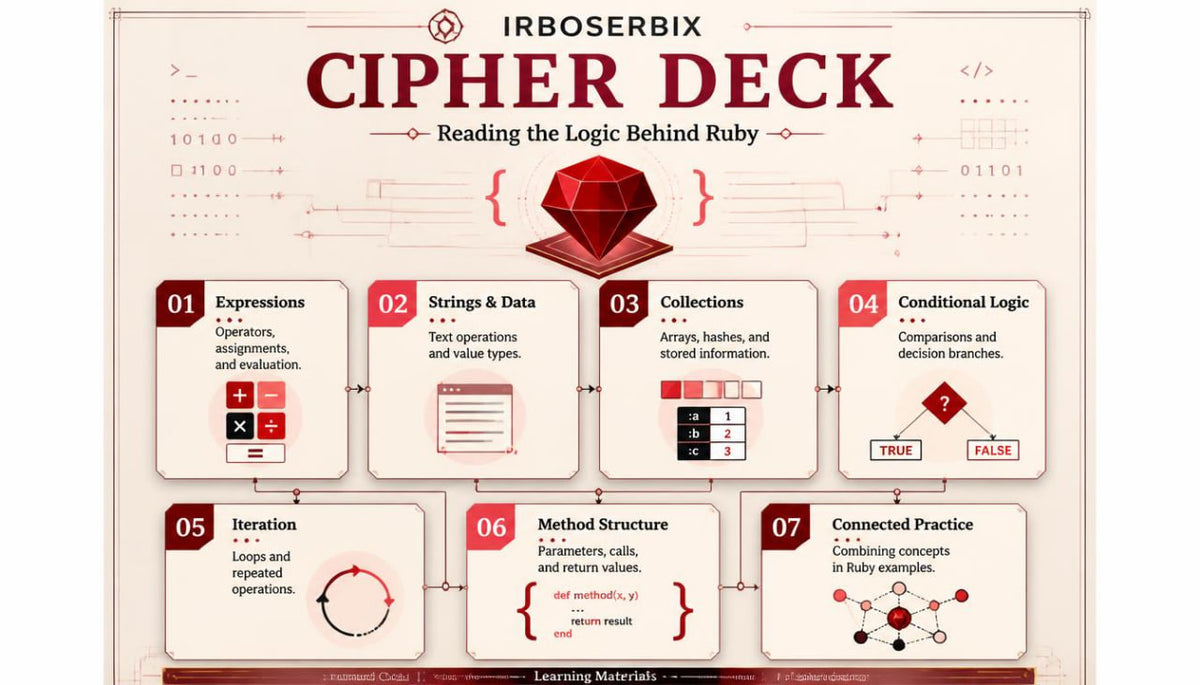
Module 01 — Understanding Ruby Expressions
The opening module revisits Ruby syntax with greater attention to the structure and evaluation of expressions.
Learners examine how values, operators, and variables interact within individual statements.
Topics include assignment operations, arithmetic expressions, comparisons, and the distinction between evaluating information and storing references to values.
Annotated examples demonstrate how expressions can be combined and how the order of operations influences the resulting output.
The module also introduces exercises involving code interpretation, expression comparison, and the identification of common syntax mistakes.
Module 02 — Working with Strings and Data
This module examines how Ruby represents and manipulates different forms of information.
Learners explore strings, numbers, Boolean values, and introductory data conversion techniques.
The section introduces common string operations, including combining text, examining character sequences, and identifying selected portions of a string.
Practical activities involve reviewing examples that organize and modify information through expressions.
Additional explanations cover the distinction between different data types and why certain operations depend on the type of value being used.
Module 03 — Collections and Information Structures
Collections provide a way to organize related information within a program.
This module explores arrays and hashes through examples involving lists, grouped values, and labeled information.
Learners examine collection indexing, element retrieval, updates, and introductory iteration techniques.
The materials explain how arrays and hashes differ in structure and how each can be used to represent particular relationships between values.
Exercises invite learners to interpret collection operations, identify changes to stored information, and compare different arrangements of the same data.
Module 04 — Decisions Within Ruby Code
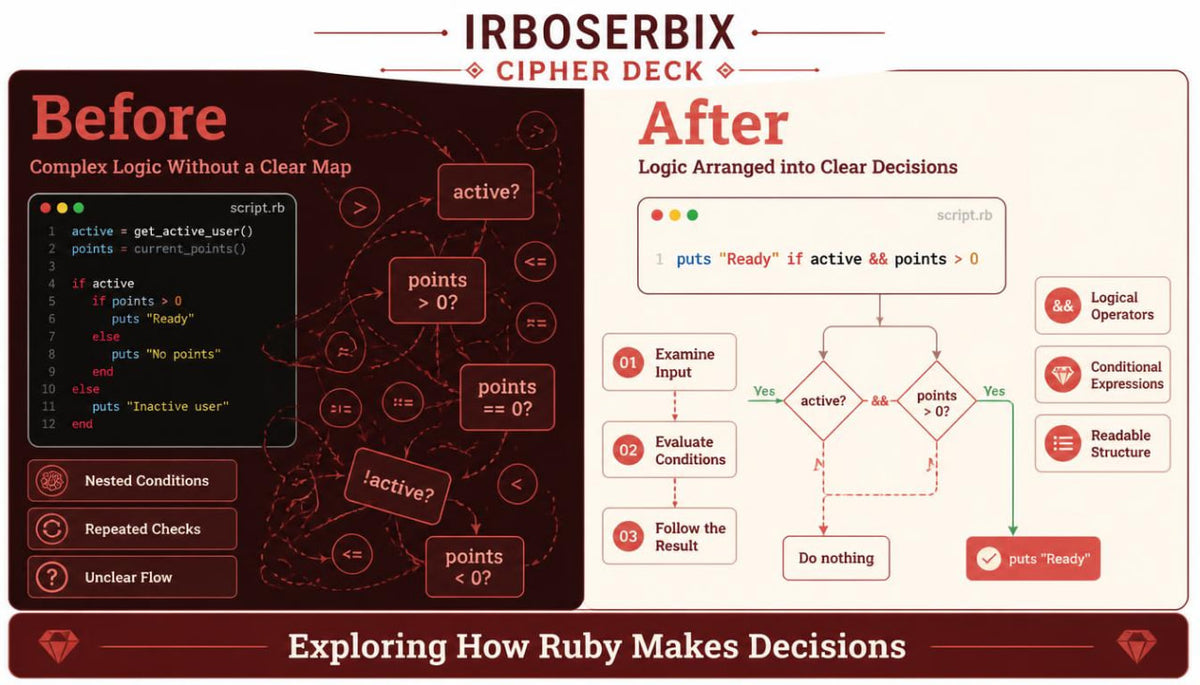
Conditional structures allow a program to select between different instructions based on evaluated expressions.
This module introduces conditional branches, comparison operators, logical expressions, and nested decision structures.
Learners investigate how Ruby evaluates conditions and how the placement of instructions influences program behavior.
Annotated examples demonstrate scenarios involving numerical comparisons, text-based conditions, and the examination of stored values.
Review activities encourage learners to follow decision paths and explain which instructions are evaluated under different circumstances.
Module 05 — Repetition and Iteration
Repetition is a fundamental part of programming when similar operations must be performed on different values.
This module examines Ruby loops and introductory iteration techniques through small, readable code examples.
Learners explore how repeated instructions operate, how iteration interacts with collections, and how changing conditions influence a loop.
The section also discusses common difficulties involving repetition, including unexpected iteration behavior and incorrect condition placement.
Exercises involve tracing repeated operations, observing changes in variable values, and comparing different ways of working through collections.
Module 06 — Methods and Code Organization
Methods provide structure by grouping related instructions into reusable sections.
This module examines method definitions, parameters, arguments, return values, and method calls.
Learners explore how information moves between different parts of a program and how methods can separate individual responsibilities.
Examples demonstrate the relationships between input values, internal calculations, and returned results.
The section also introduces descriptive naming practices and the organization of related methods into understandable code structures.
Module 07 — Bringing Concepts Together
The concluding module combines topics introduced throughout Cipher Deck into connected programming examples.
Learners examine short Ruby programs that incorporate variables, conditions, collections, iteration, and methods.
Each example is accompanied by explanations that identify the role of individual instructions and describe how information moves through the code.
Practical activities encourage learners to examine existing examples, modify selected expressions, and explain the resulting changes.
The module concludes with review questions and a guided coding activity focused on combining several Ruby concepts within one organized sequence.
Supporting Learning Materials
Alongside the main modules, Cipher Deck includes several types of educational resources:
-
Annotated Ruby examples: Code fragments with explanations of important expressions and structural relationships.
-
Guided exercises: Practical activities involving data manipulation, conditional logic, and method organization.
-
Code-reading worksheets: Tasks that invite learners to interpret instructions and describe expected behavior.
-
Concept reference notes: Written summaries of syntax structures, terminology, and programming patterns.
-
Review questions: Topic-based questions for revisiting individual concepts.
-
Practice scenarios: Small programming situations involving combinations of the subjects covered.
-
Study checklists: Organized topic lists to support independent review.
These resources are intended to complement the core lessons and encourage repeated examination of Ruby programming concepts.
4. Who Is This For? — Curious Minds Connecting the Details
Cipher Deck is intended for learners who have encountered introductory Ruby concepts and want to examine their relationships in greater detail.
The course may suit individuals familiar with basic variables, values, and programming expressions who are interested in studying conditions, collections, iteration, and methods.
It is also relevant to learners who have completed an introductory course and would like additional opportunities to work with connected code examples.
Readers who prefer structured written explanations, annotated examples, and independent exercises may find the course format suitable for their study preferences.
Cipher Deck can also serve individuals returning to Ruby after a period away from programming, particularly those interested in revisiting foundational techniques through organized materials.
The course focuses on educational exploration rather than formal certification or predefined individual outcomes.
5. What You'll Learn — Reading the Relationships Between Instructions
Cipher Deck introduces a range of Ruby programming concepts and practical study activities.
-
Expression interpretation: Examine how Ruby evaluates operators, values, and combined expressions.
-
Variable behavior: Explore assignments, references, and changes to stored information.
-
Data representation: Identify different value types and introductory conversion techniques.
-
String operations: Study common methods for working with text and character sequences.
-
Array organization: Examine indexed collections and operations involving multiple values.
-
Hash structures: Explore labeled information and key-value relationships.
-
Conditional expressions: Interpret decision branches and comparison logic.
-
Logical operators: Investigate how multiple conditions interact.
-
Iteration techniques: Follow repeated instructions and collection-based operations.
-
Method structure: Examine definitions, arguments, parameters, and returned values.
-
Data movement: Trace how information passes through connected Ruby instructions.
-
Code organization: Explore ways to divide related operations into understandable sections.
-
Error identification: Recognize selected syntax and logic issues within introductory examples.
-
Practical interpretation: Read short programs and explain how their components interact.
-
Independent review: Use worksheets and reference materials to revisit covered topics.
Individual learning experiences may vary according to previous knowledge, study habits, and engagement with the materials.
6. Course Terms and 30-Day Refund Information
Irboserbix aims to provide clear information about the educational materials included in Cipher Deck, allowing learners to review the course structure and subject matter before purchasing.
Any 30-day refund arrangement is subject to the terms stated in the store's published Refund Policy, including eligibility requirements, request procedures, and applicable rules concerning digital educational materials.
Learners should review those conditions before completing a purchase. Where a refund is permitted, the request will be handled according to the published terms and applicable consumer protection requirements.
Cipher Deck is an educational resource designed for independent Ruby study. The course does not represent a commitment to specific academic, employment, or other individual results.
The emphasis remains on transparent course information, structured learning materials, and a clear understanding of the educational content provided.
- 📥 Digital file available after purchase
- 📚 Long-term availability
- 🔒 Secure checkout
- 📅 Content updated in 2026
Self-paced learning overview
What do Irboserbix courses include?
What do Irboserbix courses include?
Irboserbix courses feature organized Ruby learning materials, written explanations, programming examples, and practical exercises. Each course explores a selection of concepts through structured modules, helping learners examine how individual programming elements work together. The specific topics and materials are outlined in each course description.
Can I study at my own pace?
Can I study at my own pace?
Yes. Irboserbix courses are designed for independent study, allowing learners to read explanations, examine coding examples, and revisit individual topics according to their own schedules. You can spend additional time reviewing unfamiliar concepts or practicing exercises before moving to another section.
Do I need previous programming knowledge?
Do I need previous programming knowledge?
The recommended starting point depends on the course you choose. Introductory materials focus on foundational Ruby concepts, while later courses explore more detailed programming structures and techniques. Each course description identifies its intended audience and the knowledge that may be helpful before beginning.
Share