Irboserbix
Drift Module
Drift Module
Couldn't load pickup availability
1. Problem Statement — When Data Takes More Than One Path
As Ruby programs begin handling larger collections and interconnected operations, understanding the movement of information becomes an important part of programming study. Learners may recognize familiar collection methods but encounter difficulties when several operations are connected into a longer sequence. Blocks, lambdas, filtering conditions, and intermediate values can introduce additional questions about how information is evaluated and passed between methods. Programs that combine data selection, modification, and output preparation may become difficult to interpret when the purpose of each operation is unclear. These situations highlight the need for educational materials that explain Ruby's data-processing techniques through connected examples, practical comparisons, and detailed examination of program behavior.
2. Solution — Bringing Order to the Movement of Information
Drift Module introduces Ruby data processing through a structured collection of lessons focused on the relationships between input values, operations, and resulting information. Each module examines a specific technique and demonstrates its behavior through annotated examples involving arrays, hashes, blocks, and methods. Guided exercises encourage learners to trace data through connected operations, compare different approaches to collection processing, and examine how individual expressions influence later instructions. The course also introduces callable objects, lazy evaluation, error handling, and introductory considerations involving processing efficiency. Through written explanations, practical activities, and organized reference materials, Drift Module provides opportunities to study how Ruby handles information across multiple programming stages.
3. What's Inside — Exploring the Movement Behind Ruby Code
Drift Module contains eight educational modules covering Ruby iteration techniques, connected data operations, and functional programming concepts.
The course builds upon previous studies of collections, methods, object-oriented structures, and program organization.
Each module combines technical explanations with annotated Ruby examples and independent review activities.
Module 01 — Understanding Data Flow
The opening module introduces data flow as the movement of information between connected programming operations.
Learners examine how values enter methods, participate in calculations, and become inputs for later instructions.
The materials revisit object references, return values, and the behavior of mutable collections.
Examples illustrate how information can move through several methods before reaching a final output.
Practice activities involve tracing values, identifying intermediate results, and describing the responsibilities of individual operations.
Module 02 — Working with Enumerable Methods
Ruby's Enumerable functionality provides a collection of techniques for examining and processing groups of values.
This module explores commonly used methods such as each, map, select, reject, find, and reduce.
Learners examine the relationship between collection elements, block parameters, and returned values.
Annotated examples demonstrate how different methods can work with the same collection while producing different results.
Exercises focus on filtering records, creating derived collections, and combining numerical information.
The section also discusses how method choice influences code readability and the organization of individual operations.
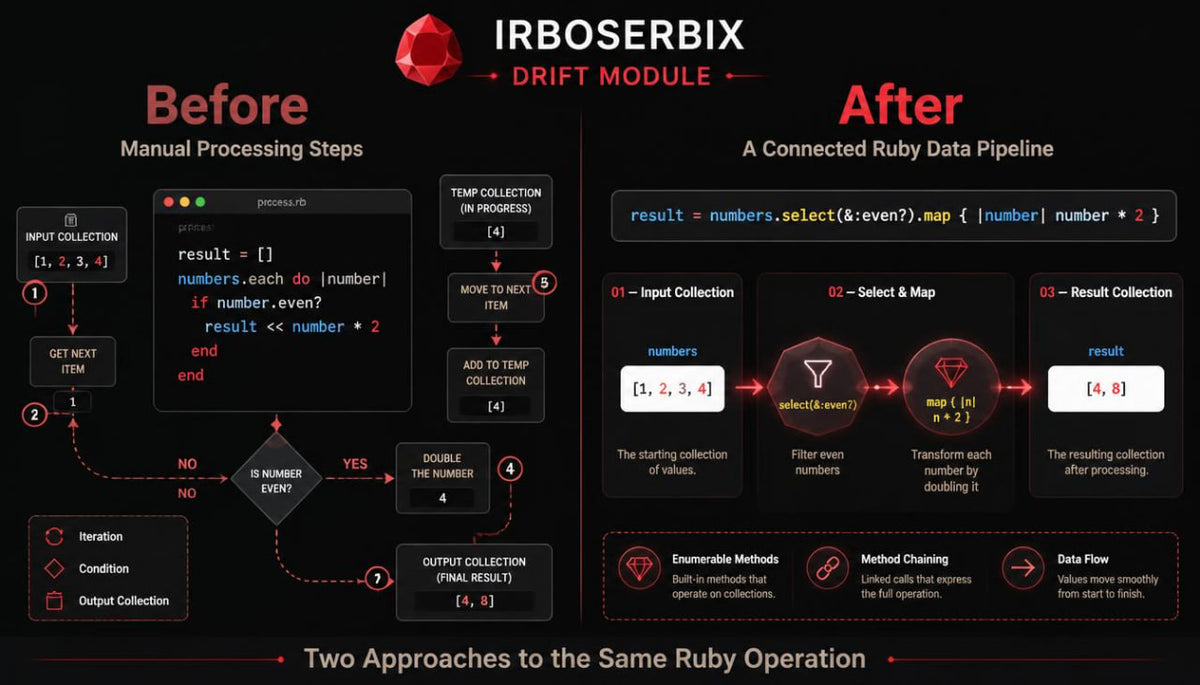
Module 03 — Building Connected Data Pipelines
A data pipeline consists of connected operations that move information through several processing stages.
This module introduces method chaining and examines how the result of one operation becomes the input for another.
Learners explore examples involving filtering, sorting, grouping, and preparing collection values.
The materials explain intermediate results and the importance of understanding the type of information returned by each method.
Annotated examples compare a sequence written as separate instructions with a connected chain of collection operations.
Practical exercises invite learners to trace values through a pipeline and describe the purpose of each stage.
Module 04 — Blocks, Procs, and Lambdas
Ruby provides several mechanisms for representing behavior that can be supplied to methods or stored for later use.
This module examines blocks, Proc objects, and lambdas through introductory examples.
Learners explore how callable objects receive arguments and return information.
The section compares their behavior, including differences in argument handling and return semantics.
Examples demonstrate using lambdas for selected calculations, collection filtering, and reusable operations.
Guided activities encourage learners to interpret callable structures and examine their relationships with surrounding methods.
Module 05 — Exploring Functional Programming Concepts
Functional programming introduces an approach to organizing operations around functions, values, and predictable behavior.
This module examines selected functional ideas through Ruby examples.
Learners explore the distinction between operations that return new values and operations that modify existing objects.
The materials introduce side effects and explain why they can influence how connected instructions are interpreted.
Examples demonstrate processing collections without modifying the original data.
Exercises encourage learners to compare alternative implementations and observe differences in their effects on stored information.
Module 06 — Lazy Evaluation and Collection Processing
Certain programming situations involve collections that do not need to be evaluated entirely at once.
This module introduces lazy evaluation through Ruby's Enumerator and related techniques.
Learners examine the relationship between iteration, deferred operations, and the point at which values are requested.
Annotated examples demonstrate how a sequence of operations may be evaluated only when its results are needed.
The materials also introduce introductory considerations involving memory usage and processing order.
Practical activities focus on interpreting lazy collection behavior and comparing it with direct evaluation.
Module 07 — Errors and Data Validation
Data-processing workflows may encounter missing values, unexpected types, or information that does not match the expected structure.
This module examines approaches to validating input before applying additional operations.
Learners review conditional checks, introductory exception handling, and the interpretation of error messages.
The materials demonstrate how validation can be arranged within methods and connected processing stages.
Examples include checking collection contents, examining string values, and responding to unexpected information.
Review exercises invite learners to identify where validation takes place and how different inputs affect later operations.
Module 08 — The Ruby Data Flow Workshop
The concluding module connects the course topics through a guided programming activity involving structured information.
Learners examine a small program that receives records, organizes them into collections, applies selection conditions, and prepares a categorized summary.
The activity begins with a description of the input information and the operations required to examine it.
Subsequent stages introduce collection methods, callable objects, validation checks, and connected processing sequences.
Annotated explanations describe the movement of values between different sections.
The workshop concludes with code-reading questions and activities involving alternative arrangements of the processing steps.
Additional Learning Materials
Drift Module includes supporting educational resources for reviewing the concepts introduced throughout the course:
-
Annotated Ruby examples: Detailed explanations of collection operations, method chains, and callable objects.
-
Data pipeline diagrams: Visual references illustrating the movement of information between processing stages.
-
Enumerable reference notes: Written descriptions of selected collection methods and their returned values.
-
Block and lambda worksheets: Exercises involving callable objects, arguments, and method interactions.
-
Functional programming comparisons: Examples examining object modification and value-returning operations.
-
Lazy evaluation activities: Guided questions concerning processing order and deferred evaluation.
-
Data validation exercises: Scenarios involving unexpected inputs and conditional checks.
-
Code-reading challenges: Activities focused on interpreting connected Ruby operations.
-
Workshop review materials: Questions and explanations accompanying the concluding programming activity.
These resources provide additional opportunities to examine individual concepts and revisit the relationships between different processing techniques.
4. Who Is This For? — For Curious Minds Following the Flow of Data
Drift Module is intended for individuals who have studied foundational Ruby programming and want to explore more detailed approaches to processing information.
The course may suit learners familiar with arrays, hashes, methods, blocks, and introductory object-oriented structures.
It is also relevant to those interested in understanding how collection operations can be connected into readable processing sequences.
Readers who have encountered lengthy method chains or unfamiliar callable structures may find the explanatory materials useful for interpreting their behavior.
The course can serve individuals revisiting Ruby collection methods and studying introductory functional programming concepts.
Its learning format emphasizes written explanations, practical examples, independent exercises, and opportunities for repeated review.
Previous familiarity with Ruby methods, collections, and basic program organization is recommended.
5. What You'll Learn — From Individual Values to Connected Operations
Drift Module introduces the following Ruby programming concepts and practical study activities:
-
Data flow: Trace how information moves through connected programming operations.
-
Enumerable methods: Examine iteration, selection, mapping, and aggregation techniques.
-
Method chaining: Interpret connected sequences of collection operations.
-
Collection filtering: Study how conditions identify selected values.
-
Data grouping: Explore methods for organizing related information.
-
Blocks: Examine block parameters, execution, and returned values.
-
Proc objects: Study callable objects and their interaction with Ruby methods.
-
Lambdas: Explore callable expressions and argument behavior.
-
Functional concepts: Investigate value-returning operations and side effects.
-
Object modification: Distinguish between modifying existing objects and creating new values.
-
Lazy evaluation: Examine deferred collection operations.
-
Data validation: Study introductory techniques for checking input information.
-
Error interpretation: Recognize selected issues within processing workflows.
-
Code organization: Explore how connected operations can be divided into understandable stages.
-
Practical data processing: Examine programming examples combining several Ruby techniques.
These learning objectives describe the technical subjects and activities presented in Drift Module. Individual progress depends on previous knowledge, study habits, and engagement with the educational materials.
6. Course Terms — 30-Day Refund Information
Drift Module is presented as a digital educational course containing structured written lessons, Ruby examples, practical exercises, diagrams, and reference materials.
Learners are encouraged to review the course contents, recommended background knowledge, and educational format before purchasing.
Where the published Irboserbix Refund Policy provides a 30-day refund period, requests submitted during that period will be considered according to its stated conditions.
The policy should explain eligibility requirements, request procedures, applicable exceptions, and the handling of digital educational materials.
Relevant consumer protection requirements also apply when determining cancellation and refund rights.
Drift Module is intended for independent Ruby programming study and does not establish predetermined academic, employment, or individual learning outcomes.
Its purpose is to provide organized technical explanations, structured educational resources, and practical activities for examining Ruby data-processing techniques.
- 📥 Digital file available after purchase
- 📚 Long-term availability
- 🔒 Secure checkout
- 📅 Content updated in 2026
Self-paced learning overview
What do Irboserbix courses include?
What do Irboserbix courses include?
Irboserbix courses feature organized Ruby learning materials, written explanations, programming examples, and practical exercises. Each course explores a selection of concepts through structured modules, helping learners examine how individual programming elements work together. The specific topics and materials are outlined in each course description.
Can I study at my own pace?
Can I study at my own pace?
Yes. Irboserbix courses are designed for independent study, allowing learners to read explanations, examine coding examples, and revisit individual topics according to their own schedules. You can spend additional time reviewing unfamiliar concepts or practicing exercises before moving to another section.
Do I need previous programming knowledge?
Do I need previous programming knowledge?
The recommended starting point depends on the course you choose. Introductory materials focus on foundational Ruby concepts, while later courses explore more detailed programming structures and techniques. Each course description identifies its intended audience and the knowledge that may be helpful before beginning.
Share