Irboserbix
Free Sphere
Free Sphere
Couldn't load pickup availability
1. Problem Statement — When Code Feels Like an Unfamiliar Language
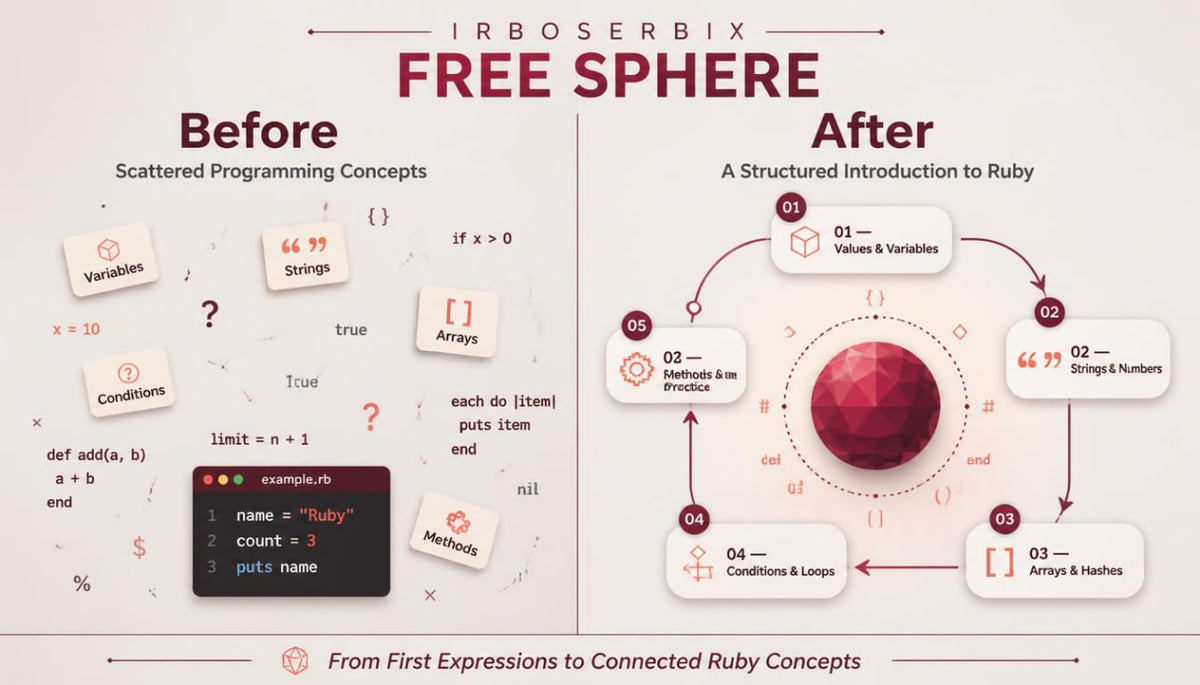
Encountering programming for the first time often means meeting unfamiliar symbols, expressions, and technical terms without knowing how they connect. A beginner may understand an individual explanation but struggle to recognize how several instructions form a meaningful sequence. Variables, values, conditions, and methods can appear unrelated when they are introduced without a clear learning structure. Reading programming examples may also raise questions about why certain instructions appear in a particular order or how Ruby interprets them. These challenges create a need for introductory materials that explain the relationships between fundamental concepts while providing opportunities to examine them through practical examples.
2. Solution — Building Understanding One Concept at a Time
Free Sphere introduces Ruby through a structured collection of beginner-oriented lessons that connect programming terminology with readable examples. Each module focuses on a defined topic and explains how that concept contributes to the behavior of a simple program. Short exercises encourage learners to observe instructions, compare different expressions, and consider how changing a value affects the resulting output. The course also introduces code-reading activities that support a more thoughtful approach to understanding programming structures. By connecting explanations, examples, and review questions, Free Sphere provides an organized starting point for further Ruby study.
3. What's Inside — A Closer Look at the Materials
Free Sphere is organized into introductory learning sections that present fundamental Ruby concepts in a gradual sequence. Rather than introducing many unrelated techniques at once, the materials concentrate on smaller groups of ideas and the connections between them.
Module 01 — Entering the World of Ruby
This opening module introduces Ruby as a programming language and examines how written instructions communicate operations.
Learners explore the general structure of Ruby code, the purpose of expressions, and the relationship between instructions and their resulting behavior.
The materials include introductory terminology, annotated examples, and short reading activities that highlight how programming statements are organized.
Module 02 — Working with Values and Variables
The second module focuses on the information that Ruby programs can represent and manipulate.
Topics include numbers, text values, basic calculations, and the role of variables in storing references to information.
Examples demonstrate how values can be assigned, reused, and combined in expressions.
Learners examine small code fragments and answer questions about how changes to variables influence later instructions.
Module 03 — Collections and Organized Information
This section introduces arrays and hashes as ways of arranging related information.
Learners investigate how collections can hold several values, how individual elements are identified, and how data can be retrieved from a collection.
Annotated examples illustrate simple collections of numbers, names, and descriptive information.
Exercises invite learners to compare collection structures and identify situations where different arrangements may be useful.
Module 04 — Decisions and Repeated Instructions
Programming becomes more interesting when instructions respond to different conditions or repeat an operation.
This module introduces conditional expressions, comparisons, and introductory repetition structures.
Learners examine how Ruby determines which instructions to evaluate when a condition changes.
Small examples demonstrate the relationship between conditions, repeated operations, and the order in which statements are executed.
Module 05 — Introducing Methods
Methods provide a way to group instructions under a meaningful name.
This module explains the purpose of method definitions, parameters, arguments, and returned values through introductory examples.
Learners read short methods and consider how the information supplied to them influences their behavior.
The section also discusses descriptive naming and the value of organizing related instructions into recognizable sections.
Module 06 — Reading, Reviewing, and Practicing
The final module brings earlier topics together through guided code-reading activities and short exercises.
Learners examine examples containing variables, collections, conditions, and methods, identifying the role of each component.
Review questions invite learners to explain what an instruction does, predict an output, and compare alternative expressions.
The module concludes with a compact reference section covering terminology and programming structures introduced throughout the course.
Additional Learning Materials
The course structure also includes several types of supporting material:
-
Annotated code examples: Short Ruby fragments accompanied by explanations of individual instructions and expressions.
-
Concept summaries: Written reference notes highlighting terminology, syntax patterns, and important distinctions.
-
Practice worksheets: Questions involving code interpretation, value comparisons, and small programming tasks.
-
Review prompts: Activities encouraging learners to explain programming concepts in their own words.
-
Topic checklists: Organized lists of subjects for reviewing the material before moving to another module.
These materials are intended to complement the written lessons and provide opportunities for repeated study.
4. Who Is This For?
Free Sphere is intended for individuals who are curious about Ruby and want an introduction to its fundamental concepts.
The course may be suitable for learners who have not studied programming before and would like to become familiar with basic terminology, code structure, and programming expressions.
It can also serve readers who have encountered programming examples but want to revisit variables, collections, conditions, and methods in an organized sequence.
Individuals comparing different areas of programming may find the introductory modules useful for examining Ruby's language structure.
The materials are particularly relevant to people who prefer written explanations, short examples, self-guided exercises, and the freedom to revisit individual sections.
No prior Ruby knowledge is expected for the introductory topics covered here.
5. What You'll Learn — From Symbols to Structured Thinking
By studying the materials and completing the activities, learners can explore the following subjects:
-
Ruby syntax fundamentals: Recognize common instructions, expressions, and structural elements.
-
Variables and assignments: Examine how Ruby associates variable names with values.
-
Basic data types: Identify numbers, strings, Boolean values, and their roles in introductory examples.
-
Arithmetic and expressions: Explore calculations, operators, and the evaluation of expressions.
-
Working with strings: Study text representation, concatenation, and introductory string operations.
-
Arrays and hashes: Examine how related values can be organized and retrieved.
-
Conditional logic: Interpret basic conditions and identify how they affect instruction flow.
-
Repetition structures: Explore introductory loops and repeated operations.
-
Method definitions: Identify parameters, arguments, method calls, and returned values.
-
Code interpretation: Practice reading short Ruby examples and explaining their behavior.
-
Error awareness: Become familiar with common introductory syntax mistakes and review techniques.
-
Programming vocabulary: Develop familiarity with terminology used throughout Ruby learning materials.
These learning objectives describe the topics presented in Free Sphere rather than a required level of individual achievement.
6. Guarantee and Refund Information
Free Sphere is provided without a purchase charge, allowing learners to explore the introductory materials without making a payment.
Because the course carries no purchase charge, a 30-day money-back arrangement does not apply to this particular course. There is no payment to return.
For paid Irboserbix courses, any 30-day refund arrangement must follow the conditions stated in the store's published Refund Policy, including applicable eligibility requirements and request procedures.
Free Sphere is intended as a straightforward introduction to the Irboserbix learning format, with clearly described educational topics and no claims regarding specific individual results.
- 📥 Digital file available after purchase
- 📚 Long-term availability
- 🔒 Secure checkout
- 📅 Content updated in 2026
Self-paced learning overview
What do Irboserbix courses include?
What do Irboserbix courses include?
Irboserbix courses feature organized Ruby learning materials, written explanations, programming examples, and practical exercises. Each course explores a selection of concepts through structured modules, helping learners examine how individual programming elements work together. The specific topics and materials are outlined in each course description.
Can I study at my own pace?
Can I study at my own pace?
Yes. Irboserbix courses are designed for independent study, allowing learners to read explanations, examine coding examples, and revisit individual topics according to their own schedules. You can spend additional time reviewing unfamiliar concepts or practicing exercises before moving to another section.
Do I need previous programming knowledge?
Do I need previous programming knowledge?
The recommended starting point depends on the course you choose. Introductory materials focus on foundational Ruby concepts, while later courses explore more detailed programming structures and techniques. Each course description identifies its intended audience and the knowledge that may be helpful before beginning.
Share