Irboserbix
Motion Stage
Motion Stage
Couldn't load pickup availability
1. Problem Statement — When Every Part of the Code Must Work Together
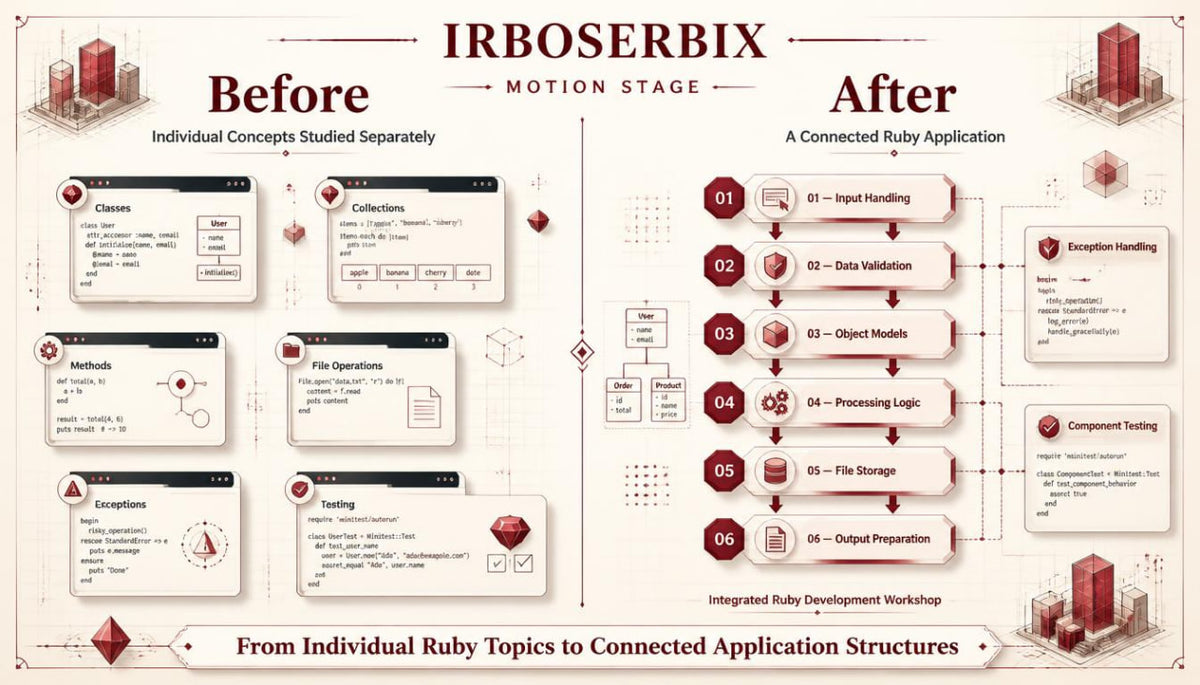
Working with individual Ruby concepts is different from organizing them into a connected application containing multiple classes, methods, and processing operations. As programming structures grow, learners may encounter difficulties deciding how data should move between components and where particular responsibilities belong. Managing stored information, responding to unexpected inputs, and coordinating methods across several source files introduces additional architectural considerations. Testing individual operations becomes more involved when their behavior depends on surrounding objects, configuration values, and shared data structures. These challenges create a need for educational materials that examine the complete development process through connected examples, structured explanations, and practical programming activities.
2. Solution — Studying Ruby as a Connected System
Motion Stage presents an integrated approach to Ruby programming by examining how individual language concepts contribute to the organization of a larger application. The course combines object-oriented design, collection processing, file operations, testing techniques, and code organization within a progressive collection of learning modules. Annotated examples demonstrate the relationships between architectural decisions, method responsibilities, and the movement of information through connected components. Guided exercises encourage learners to examine existing implementations, compare alternative structures, and investigate how modifications influence program behavior. A concluding development workshop brings the course subjects together through a multi-component Ruby project accompanied by explanations, review questions, and technical reference materials.
3. What's Inside — Exploring the Full Structure of Ruby Development
Motion Stage contains ten interconnected educational modules that bring together foundational concepts and more detailed Ruby programming techniques.
The materials emphasize relationships between different parts of an application, from initial structural planning to data operations, testing, and code revision.
Each module introduces a defined topic through written explanations, annotated examples, and independent study activities.
Module 01 — Understanding the Anatomy of a Ruby Application
The opening module examines how several programming components can contribute to a shared purpose.
Learners investigate application responsibilities, data movement, class relationships, and the organization of source files.
The materials introduce architectural planning through examples containing several cooperating Ruby objects.
Annotated diagrams illustrate relationships between input handling, processing operations, and output preparation.
Activities encourage learners to identify individual components and explain their roles within a connected application.
Module 02 — Planning Classes and Object Relationships
This module examines the decisions involved in arranging information and behavior across Ruby classes.
Learners explore object responsibilities, constructors, instance variables, public methods, and internal operations.
The materials compare inheritance, composition, and method delegation through practical examples.
Special attention is given to the relationships between cooperating objects and the information exchanged during method calls.
Exercises involve examining class definitions, tracing interactions, and comparing alternative approaches to organizing responsibilities.
Module 03 — Organizing Data and Collections
Applications frequently rely on structured information stored in arrays, hashes, and interconnected objects.
This module explores techniques for representing records, categories, and relationships between values.
Learners examine nested collections, object-based records, and introductory approaches to validating stored information.
Examples demonstrate retrieving, updating, filtering, and grouping related values.
The materials also introduce questions about data consistency and the handling of unexpected information.
Practice activities involve examining collection structures and interpreting changes across connected operations.
Module 04 — Developing Reusable Processing Operations
Related programming tasks can be divided into methods with clearly described responsibilities.
This module examines how Ruby methods can organize repeated operations and coordinate data processing.
Learners explore method arguments, returned values, keyword arguments, and the use of helper methods.
Annotated examples demonstrate how a longer processing sequence can be divided into individual stages.
The materials also discuss method naming, code readability, and the relationship between input preparation and subsequent calculations.
Exercises encourage learners to compare method arrangements and trace information through several operations.
Module 05 — Blocks and Functional Programming Techniques
Ruby offers a flexible collection of mechanisms for working with repeated operations and callable behavior.
This module examines blocks, Proc objects, lambdas, and selected Enumerable methods.
Learners investigate collection mapping, filtering, grouping, and aggregation.
The materials introduce functional programming ideas through examples that compare modifying existing objects with returning new values.
Annotated exercises demonstrate how several collection methods can participate in a connected processing sequence.
Review questions focus on returned values, side effects, and the relationships between callable objects and surrounding methods.
Module 06 — Working with Stored Information
Applications may need to read, organize, and write information beyond values held directly in memory.
This module introduces text-based file operations and the representation of structured information.
Learners examine reading content, writing records, interpreting lines, and organizing file-related methods.
The materials also discuss missing files, unexpected content, and introductory data validation.
Examples demonstrate how stored information can enter a Ruby application and participate in subsequent processing operations.
Practical activities involve examining file-handling instructions and tracing information between storage and program components.
Module 07 — Error Handling and Application Behavior
Connected applications can encounter unexpected values, missing information, and operations that cannot be completed as intended.
This module explores Ruby exception handling and the interpretation of runtime errors.
Learners examine begin, rescue, ensure, and raise through annotated examples.
The materials discuss the distinction between preventing invalid operations and responding to errors after they occur.
Guided activities involve identifying exception conditions, reviewing error messages, and tracing execution paths.
The section also introduces approaches to keeping error-handling responsibilities understandable within larger methods.
Module 08 — Testing Connected Components
Testing provides a structured way to examine individual operations and interactions between components.
This module introduces the organization of test cases, assertions, and controlled input scenarios.
Learners explore unit testing, introductory integration testing, and the examination of boundary conditions.
Examples demonstrate how methods can be examined independently and how object collaboration influences test preparation.
The materials also introduce dependency isolation and the use of representative objects during testing.
Activities involve describing expected behavior, comparing observed results, and examining changes after code revisions.
Module 09 — Reviewing and Refining Application Structure
Program organization may change as additional functionality and responsibilities are introduced.
This module examines refactoring and the evaluation of existing Ruby code structures.
Learners investigate lengthy methods, repeated logic, unclear naming, and dependencies between components.
Annotated comparisons illustrate how code can be reorganized while retaining its intended observable behavior.
The materials introduce techniques for dividing responsibilities, extracting methods, and reconsidering object relationships.
Review activities encourage learners to describe structural changes and explain the reasoning behind alternative arrangements.
Module 10 — The Motion Stage Development Workshop
The concluding module combines the course subjects through a guided Ruby application study.
Learners examine an information-management application designed around several cooperating components.
The workshop begins with a description of the application's purpose, the information it handles, and the relationships between its responsibilities.
Subsequent sections explore class definitions, collection processing, file operations, input validation, and object collaboration.
Testing activities examine selected methods and connected operations using defined input scenarios.
The final stage introduces structural review questions, including how responsibilities are divided and how information travels between components.
The workshop concludes with a written analysis of the application's organization and suggestions for independent experimentation.
Additional Learning Materials
Motion Stage includes a collection of supporting educational resources:
-
Annotated Ruby code examples: Detailed explanations of methods, classes, and connected operations.
-
Architecture diagrams: Visual references showing component relationships and information movement.
-
Data organization worksheets: Activities involving collections, object relationships, and structured information.
-
Method design exercises: Tasks examining arguments, returned values, and related responsibilities.
-
Functional programming references: Notes describing blocks, lambdas, and collection operations.
-
Error investigation scenarios: Guided examples of exception handling and unexpected behavior.
-
Testing worksheets: Activities involving assertions, sample inputs, and expected outputs.
-
Refactoring comparisons: Before-and-after examples of different code arrangements.
-
Application study materials: Guided explanations accompanying the concluding development workshop.
-
Technical review checklists: Organized topics for revisiting the relationships between course modules.
These resources complement the main lessons and provide opportunities to revisit individual concepts while examining their role within connected Ruby applications.
4. Who Is This For? — For Learners Ready to Connect the Entire Picture
Motion Stage is intended for individuals who have already studied Ruby fundamentals and want to examine how different programming techniques operate within a larger application.
The course may suit learners familiar with classes, modules, methods, collections, object collaboration, and introductory testing concepts.
It is also relevant to readers interested in program architecture, data handling, error analysis, and the organization of multi-file Ruby projects.
Individuals who have previously examined isolated programming examples may find the integrated workshop useful for studying the relationships between different technical subjects.
Motion Stage can also serve as a structured reference for revisiting object-oriented programming, data processing, testing, and refactoring.
The educational format emphasizes detailed written explanations, annotated code, independent exercises, and a connected programming study project.
Previous experience reading and interpreting class-based Ruby code is recommended.
5. What You'll Learn — Connecting Ruby Concepts into a Larger Picture
Motion Stage introduces the following technical subjects and practical learning activities:
-
Application architecture: Examine the arrangement of multiple Ruby components.
-
Object-oriented design: Study classes, objects, responsibilities, and collaboration.
-
Composition and inheritance: Compare approaches to organizing shared behavior.
-
Method delegation: Explore communication between cooperating objects.
-
Data representation: Examine arrays, hashes, and object-based information structures.
-
Collection processing: Study filtering, mapping, grouping, and aggregation.
-
Callable objects: Explore blocks, Proc objects, and lambdas.
-
File operations: Examine reading, writing, and organizing stored information.
-
Input validation: Study techniques for checking values before further processing.
-
Exception handling: Interpret Ruby error conditions and response structures.
-
Testing strategies: Examine unit tests, connected components, and boundary cases.
-
Dependency organization: Explore relationships between interacting classes.
-
Code refactoring: Study structural revisions that preserve intended behavior.
-
Multi-file organization: Examine how Ruby definitions can be arranged across source files.
-
Integrated programming: Investigate a connected application through a guided development workshop.
-
Code review: Describe architectural decisions, information flow, and component responsibilities.
These learning objectives describe the technical concepts and educational activities covered in Motion Stage. Individual understanding and progress vary according to prior knowledge, study time, and engagement with the materials.
6. Course Terms — 30-Day Refund Information
Motion Stage is presented as a digital Ruby programming course containing structured written lessons, annotated coding examples, practical exercises, architectural diagrams, and reference materials.
Learners are encouraged to review the course outline, recommended background knowledge, and included educational resources before purchasing.
Where the published Irboserbix Refund Policy provides a 30-day refund period, learners may submit a request within 30 days of purchase according to the stated procedures.
Refund eligibility, applicable exceptions, and the handling of digital educational materials are governed by the published policy and relevant consumer protection requirements.
The applicable terms should be reviewed before completing a purchase, including any conditions concerning the delivery of digital materials.
Motion Stage is intended for independent Ruby programming study and does not establish predetermined educational, employment, or individual outcomes.
Its focus remains on transparent course information, connected technical explanations, and detailed activities that encourage the examination of Ruby application structures.
- 📥 Digital file available after purchase
- 📚 Long-term availability
- 🔒 Secure checkout
- 📅 Content updated in 2026
Self-paced learning overview
What do Irboserbix courses include?
What do Irboserbix courses include?
Irboserbix courses feature organized Ruby learning materials, written explanations, programming examples, and practical exercises. Each course explores a selection of concepts through structured modules, helping learners examine how individual programming elements work together. The specific topics and materials are outlined in each course description.
Can I study at my own pace?
Can I study at my own pace?
Yes. Irboserbix courses are designed for independent study, allowing learners to read explanations, examine coding examples, and revisit individual topics according to their own schedules. You can spend additional time reviewing unfamiliar concepts or practicing exercises before moving to another section.
Do I need previous programming knowledge?
Do I need previous programming knowledge?
The recommended starting point depends on the course you choose. Introductory materials focus on foundational Ruby concepts, while later courses explore more detailed programming structures and techniques. Each course description identifies its intended audience and the knowledge that may be helpful before beginning.
Share